

The next step in private healthcare: what happens after the diagnosis?

Updated: May 1
The next growth frontier in private healthcare is no longer in diagnostics
Over the past decade, one of the most important competitive advantages for private healthcare providers has been the expansion of diagnostic capacity. Faster examinations, more accurate results, more complex screening packages — a significant portion of the market has built its growth on these foundations.
Today, however, more and more providers are facing a less tangible, yet strategically critical question:
how can patients be retained within the system after the diagnosis?
International trends are clear
According to analyses by the World Health Organization and McKinsey & Company, one of the greatest challenges in healthcare systems today is no longer recognition, but execution.
In most lifestyle-related conditions, a significant gap emerges between diagnosis and actual behavioral change. Patients understand the recommendations, but rarely manage to integrate them into their daily lives over the long term.
This phenomenon — increasingly referred to in the literature as the “treatment gap” — is not only a healthcare issue, but also a defining business challenge.
The invisible business loss
For most private healthcare providers, the operational logic remains largely linear:
assessment → diagnosis → recommendation → exit
The patient leaves, and although they may return in theory, the intensity of the relationship is broken. The consequences are not immediate, but they are substantial:
the patient lifetime value remains limited
revenue does not evolve into a recurring model
the provider does not become a long-term partner to the patient
In this model, the system delivers information, but rarely provides a structured solution.
The shift in model: from service to system
An increasing number of players in the international market are moving beyond this point, complementing their diagnostic focus with a second layer: implementation.
This does not necessarily mean traditional medical treatment. Rather, it involves low-barrier yet effective solutions that:
support lifestyle change
facilitate recovery
and bring patients back on a regular basis
Providers who take this step effectively move to a new level of operation: they no longer offer a service — they build a system.
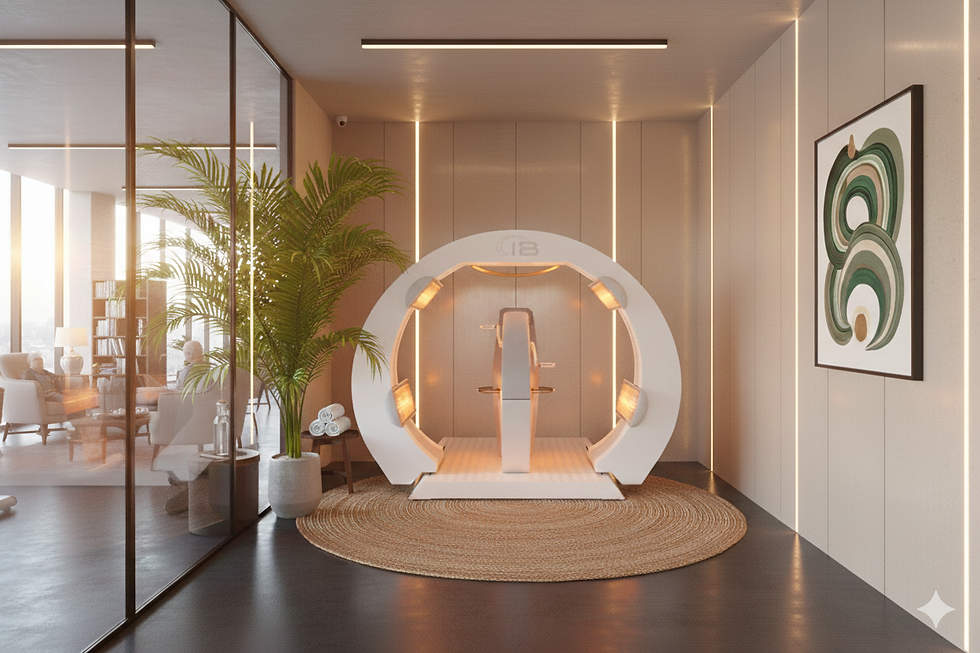
A concrete direction: how do these solutions appear in practice?
In recent years, several technological solutions have emerged that specifically address this “post-diagnosis phase.”
These include systems that combine:
infrared heat exposure
low-impact movement
and circulation-enhancing effects
into a single, easy-to-apply format.
One of the more advanced implementations of this approach is the INFRAMEBIKE technology, which:
provides a semi-recumbent, joint-friendly form of movement
supports metabolic and circulatory processes through infrared heat
can be applied as a complementary tool for regeneration and lifestyle support
It is important to emphasize: these solutions do not replace medical treatments — they complement them, enabling patients to actually implement the recommended changes.
Why is this relevant for private healthcare providers?
The introduction of such technologies allows providers to:
remain actively present in the patient’s life even after diagnosis
offer structured programs (e.g. weight management, regeneration)
communicate based on measurable outcomes
and build new, recurring revenue streams
This is particularly advantageous for providers where:
a high volume of lifestyle-related conditions is present
long-term patient retention is a strategic objective
From the perspective of the Hungarian market
The domestic private healthcare sector is now reaching a point where diagnostic capacity alone is no longer a sufficient competitive advantage.
The next step will be taken by those providers who:
are able to control the next phase of the patient journey
and turn recommendations into practical solutions
The real question
is not whether there is a need for these types of solutions, but rather:
how they can be integrated into existing operations in a way that creates real business and professional value.
Next step
Developments of this kind do not start with choosing a device, but with operational questions:
where it fits into the patient journey
how it appears as a structured program
how results can be measured
Mapping these factors is most effective within the framework of a short professional consultation.
Comments