

How can hotels increase guest experience and revenue with innovative wellness technologies?

Updated: May 1
The premium hotel industry is currently experiencing one of its fastest transformations in the area of wellness and fitness services. What was considered a pleasant add-on a decade ago has now become a key driver of guest experience and hotel positioning.
Modern travelers — especially those choosing higher-category accommodations — are no longer simply looking for a comfortable room. They increasingly expect complex experiences that simultaneously support:
regeneration
health preservation
active recreation
and overall quality of life
This shift is clearly visible in the Hungarian hotel market as well. Many premium hotels in Budapest and leading tourist regions are already competing with comprehensive wellness infrastructures.
However, the real question today is no longer whether to offer wellness, but rather:
how to create a service that enhances guest experience while remaining economically sustainable.
The wellness department as a business engine
A well-functioning wellness department goes far beyond offering relaxation. In modern hotel management, it is increasingly viewed as a profit center.
Direct and indirect business impacts of wellness services
Direct impacts
paid treatments and programs
sales of premium services
wellness packages
attracting external (non-staying) guests
Indirect impacts
higher acceptance of room rates
longer length of stay
more returning guests
improved guest reviews
stronger brand positioning
It is no coincidence that wellness has become a central element of marketing and positioning in many hotels today.
What is considered a baseline expectation today?
In most 4–5 star hotels, wellness infrastructure is built on similar foundations.
Typical services:
pool
jacuzzi
sauna world
massage services
fitness room
From a business perspective, these are essential foundations — but they rarely create real differentiation.
Service | Investment scale | Payback period | Guest attraction value |
Pool | HUF 80–250 million | 6–10 years | 8 |
Sauna world | HUF 15–50 million | 4–6 years | 7 |
Spa treatments | HUF 5–15 million | 2–4 years | 7 |
Fitness room | HUF 10–40 million | 4–7 years | 6 |
These are important for guests — but they are not the primary reason for choosing a hotel.
Today, real competitive advantage is created by innovation and unique experiences.
The new wellness trend: active regeneration and technology
One of the most important directions in the evolution of wellness tourism is the concept of active wellness.
This approach combines:
movement
regeneration
health preservation
technological innovation
Guests are increasingly looking for services that:
promise fast results
are easy to try
deliver visible effects
are based on modern technology
For example, movement combined with infrared technology enhances circulation, boosts metabolism, and supports muscle recovery.
This approach has given rise to a new wellness category: regenerative fitness technologies.

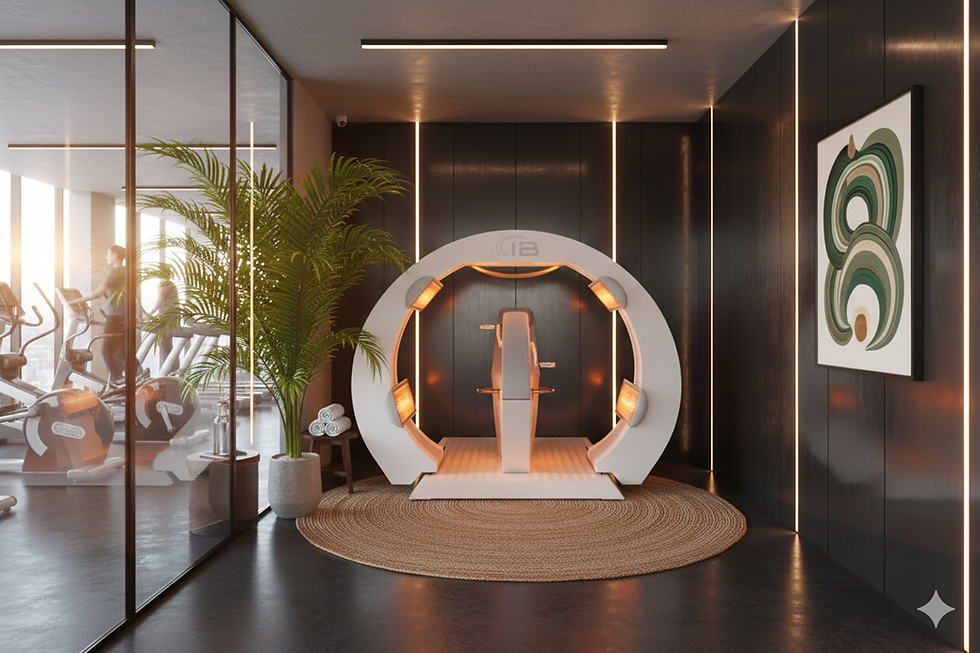
An innovative example: INFRAMEBIKE
One example of these next-generation wellness solutions is INFRAMEBIKE, which integrates multiple technological effects into a single system.
The equipment combines three key elements:
infrared heat
pulsed electromagnetic field therapy
semi-recumbent cycling movement
The system simultaneously supports:
body shaping
regeneration
increased vitality
enhanced detoxification and lymphatic function
joint-friendly movement
In addition, during a 50-minute session, users can burn up to 600–800 calories, while placing minimal strain on the joints.
A fast-return recreational and wellness service
For hotel operators, one of the most important questions regarding any new service is return on investment.
A business model for an innovative recreational and wellness technology may look like this:
Average service price HUF 5,500 – 11,000 per session
Average daily usage 4–6 guests
Potential monthly revenue HUF 660,000 – 1,320,000
Such a system can achieve payback within approximately 7–10 months.
This is particularly attractive for hotels because:
it requires minimal space
it has low staffing requirements
it can be sold as a premium service
AI support: the future of wellness services
The next stage in modern wellness technologies is the integration of artificial intelligence.
One of the biggest challenges for hotels in operating wellness services is staffing requirements.
The traditional model often looks like this:
guest → personal trainer / therapist → service
This approach is costly and difficult to scale.
AI assistant in INFRAMEBIKE usage
The INFRAMEBIKE system is complemented by an AI-supported digital assistant that guides guests through the experience.
The system enhances the guest experience through multiple functions.
Personalized usage
The AI helps guests select:
their goal (body shaping, regeneration, vitality)
the appropriate infrared intensity
the optimal training level
Technology explanation
The system clearly explains:
how infrared technology works
the mechanism of the training
recovery processes
active detoxification and lymphatic stimulation
Multilingual communication
The AI is capable of:
communicating in multiple languages
assisting guests in their native language
providing interactive guidance
Reduced staffing requirements
In practice, this means:
staff only need to introduce the equipment
guests can use the system independently
continuous professional supervision is not required
This is especially important in the hotel industry, where labor shortages and rising wage costs are ongoing challenges.
Where is the wellness hotel industry heading?
In the coming years, the most successful wellness hotels will focus on three key areas:
1. Experience-based wellnessNot just relaxation, but active experiences
2. Health and preventionVitality and lifestyle programs
3. Technological innovationBiohacking and regenerative systems
Hotels that successfully integrate these elements can gain a significant competitive advantage.
How can such innovation be integrated into a hotel’s wellness concept?
Every hotel has different characteristics:
varying wellness infrastructure
different guest segments
different business models
Therefore, the introduction of a new technology should always be designed based on a tailored concept.
If you are interested in how INFRAMEBIKE technology:
can be integrated into your wellness department
what revenue model it can offer
and what kind of guest experience it can create
we would be pleased to present it to you of a short, personalized professional consultation.
Contact and request a demo:https://www.inframebike.com/en/contact


Comments